Solid State Storage Technology Corporation (SSSTC), a subsidiary of Kioxia Corporation, has introduced its new PQ2 series of industrial-grade solid-state drives (SSDs), designed to deliver high-speed storage for AI PCs, embedded systems and industrial computing applications.
Announced on 17 November 2026 in Taipei, the PQ2 series is SSSTC’s first industrial-grade SSD range using quad-level cell (QLC) NAND flash technology.
The new drives combine a PCIe Gen4 x4 interface with Kioxia’s eighth-generation BiCS FLASH memory, offering sequential read speeds of up to 7,000 MB/s and write speeds of up to 6,200 MB/s.
The range is designed for read-intensive workloads, including applications requiring rapid access to locally stored AI models, operating systems and business data.
Introducing next-generation industrial storage
The PQ2 series uses Kioxia’s four-bit-per-cell QLC NAND flash memory, which enables greater storage density by storing multiple bits of information within each memory cell.
The technology incorporates CMOS directly Bonded to Array (CBA), a manufacturing architecture designed to improve memory density, performance and power efficiency.
According to SSSTC, combining this technology with a PCIe Gen4 interface allows the PQ2 series to deliver responsive data access while maintaining the reliability required for industrial applications.
The drives also feature a DRAM-less architecture supported by Host Memory Buffer (HMB) technology.
This allows the SSDs to use a portion of the host system’s memory for certain operations, reducing the need for dedicated DRAM components within the drive.
High-speed performance and compact configurations
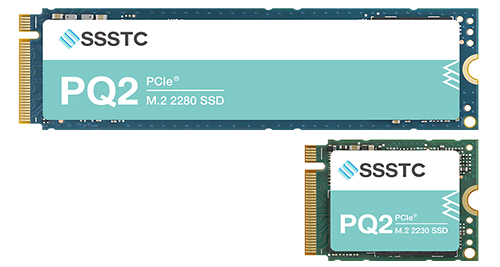
The PQ2 series supports the NVMe 2.0d specification and is available in two M.2 form factors.
These include the standard M.2 2280 format and the more compact M.2 2230 configuration, providing manufacturers with flexibility when designing devices with different space requirements.
Three storage capacities are available:
- 512 GB
- 1 TB
- 2 TB
SSSTC reports maximum sequential read speeds of 7,000 MB/s and sequential write speeds of 6,200 MB/s.
The drives also support 4 KiB random read and write performance of up to one million input/output operations per second (IOPS).
These specifications are intended to support applications that require frequent access to operating systems, software and stored information.
Actual performance will depend on the drive configuration and operating conditions.
Supporting AI PCs and embedded systems
SSSTC has developed the PQ2 range for applications where reliable storage performance and compact hardware are important.
For AI PCs, the drives can support tasks such as loading locally stored AI models and retrieving application data without relying entirely on cloud-based resources.
The range is also suitable for point-of-sale terminals, thin clients and networking devices.
In embedded systems, the drives can provide boot storage, allowing equipment to access operating software and other essential data.
The compact M.2 2230 configuration is particularly relevant to devices with limited internal space, while the larger M.2 2280 format offers another option for system designers.
SSSTC is positioning the PQ2 series as a storage solution for manufacturers developing connected, industrial and edge computing equipment.
Industrial reliability and data security
Alongside its performance capabilities, the PQ2 range incorporates features designed for industrial operating environments.
The drives offer resistance to shock and vibration and support operating temperatures ranging from 0°C to 85°C.
SSSTC also specifies a mean time between failures (MTBF) rating of three million hours.
For data security, the SSDs include AES 256-bit hardware encryption.
Optional support for TCG Opal and TCG Pyrite provides additional security configuration options for manufacturers and system integrators.
These capabilities are intended to support applications where data protection, equipment reliability and consistent operation are important.
Expanding Kioxia’s industrial storage portfolio
SSSTC has been developing SSD technology since 2008, combining in-house firmware development with NAND flash expertise.
The company became a subsidiary of Kioxia Corporation in 2020.
The introduction of the PQ2 series expands its industrial storage offering through the adoption of eighth-generation BiCS FLASH QLC memory.
By combining compact configurations, high-speed data access and industrial reliability features, SSSTC aims to address the storage requirements of AI PCs, embedded systems and connected industrial devices.
The launch reflects continued development in solid-state storage technology as manufacturers seek faster and more space-efficient solutions for increasingly data-intensive computing applications.
SOURCE SSSTC
IMAGE CREDIT SSSTC