
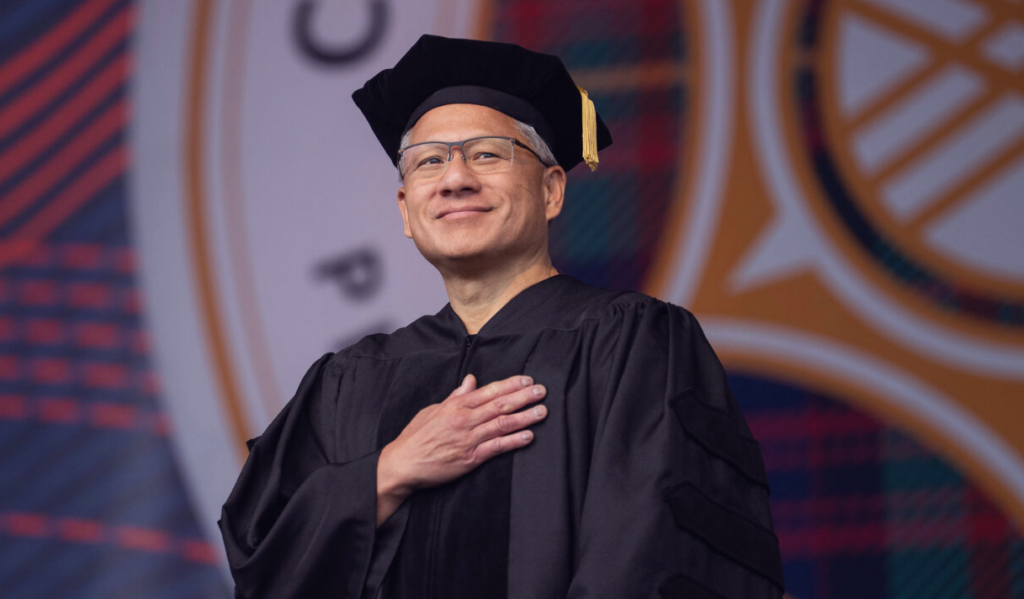
Delivering the commencement address to Carnegie Mellon University’s Class of 2026, NVIDIA founder and CEO Jensen Huang said, ‘I cannot imagine a more exciting time to begin your life’s work.’
“You are entering the world at an extraordinary moment,” NVIDIA founder and CEO Jensen Huang told graduates as he delivered the keynote address at Carnegie Mellon University’s 128th commencement ceremony on Sunday. “A new industry is being born. A new era of science and discovery is beginning.”
“No generation has entered the world with more powerful tools – or greater opportunities – than you,” said Huang, addressing the assembled thousands on a rainy morning at Gesling Stadium on the university’s main campus in Pittsburgh, Pennsylvania. “We are all standing at the same starting line. This is your moment to help shape what comes next.”
After encouraging graduates to turn to their mothers and wish them a happy Mother’s Day, Huang drew a direct parallel between starting his career at the beginning of the PC revolution and graduates starting theirs at the beginning of the AI revolution, emphasising that every major computing platform shift – PCs, the internet, mobile and cloud – had led to this shared moment.
“But what is about to happen now is bigger than anything before,” said Mr Huang. “Because intelligence is foundational to every industry, every industry will change.
“For the first time, the power of computing and intelligence can truly reach everyone and close the technology divide. Now it’s your time to realise your dreams – and the timing could not be more perfect.”
Huang described AI as driving the largest technology infrastructure buildout in human history, and a “once-in-a-generation opportunity to reindustrialise America and restore the nation’s capacity to build.”
Huang underscored that AI is making intelligence more broadly accessible — reaffirming the imperative for AI to reach everyone, not just a select few. Its opportunity extends across many industries and jobs including electricians, plumbers, ironworkers, technicians and all kinds of builders.
“Every major technological revolution in history created fear alongside opportunity,” Huang said. “When society engages technology openly, responsibly and optimistically, we expand human potential far more than we diminish it.”
Huang explained that AI automates tasks but elevates workers. The task and purpose of a job are not the same. Radiologists, for example, don’t just read scans — they care for patients. AI automates scan reading (the task) but elevates the radiologist: the purpose. The way forward for this generation, indeed for everyone, is to engage deeply with AI.
“The responsibility of our generation is not only to advance AI — but to advance it wisely,” he said, striking a chord with the commencement crowd, who cheered and applauded his next remark that “scientists and engineers have a profound responsibility to advance AI capabilities and AI safety together.”
And Huang didn’t leave out non-technical groups.
“Policymakers have a responsibility to create thoughtful guardrails that protect society while still allowing innovation, discovery and progress to move forward,” he said.
To meet the moment of the AI revolution, Huang counseled doing four things at once: “Advance safely. Create thoughtful policies. Make AI broadly accessible. And encourage everyone to engage.”
“History shows that societies that retreat from technology do not stop progress — they only surrender the opportunity to shape it and to benefit from it,” he said. “So, the answer is not to fear the future. The answer is to guide it wisely, build it responsibly and ensure that its benefits reach as many people as possible.”
Looking at the graduation class and their loved ones, Huang saw a part of himself and his own path in the United States.
“Like many in this audience, I am a first-generation immigrant,” Huang said, describing his view of America growing up as “not easy, but full of opportunities. Not a guarantee, but a chance.
“AI started right here at Carnegie Mellon,” said Huang, invoking a string of watershed moments, from CMU researchers’ creation of the Logic Theorist in the 1950s – widely considered the first AI computer program – to the foundation of the Robotics Institute, the first academic institute devoted entirely to robotics, in 1979.
Huang also received an Honorary Doctor of Science and Technology, one of the university’s highest distinctions, from CMU President Farnam Jahanian.
“Carnegie Mellon has a motto I love: ‘My heart is in the work.’ So put your heart in the work,” Huang said to conclude his address. “Build something worthy of your education, your potential and the people who believed in you long before the world did.”
For more news like this, click here.