
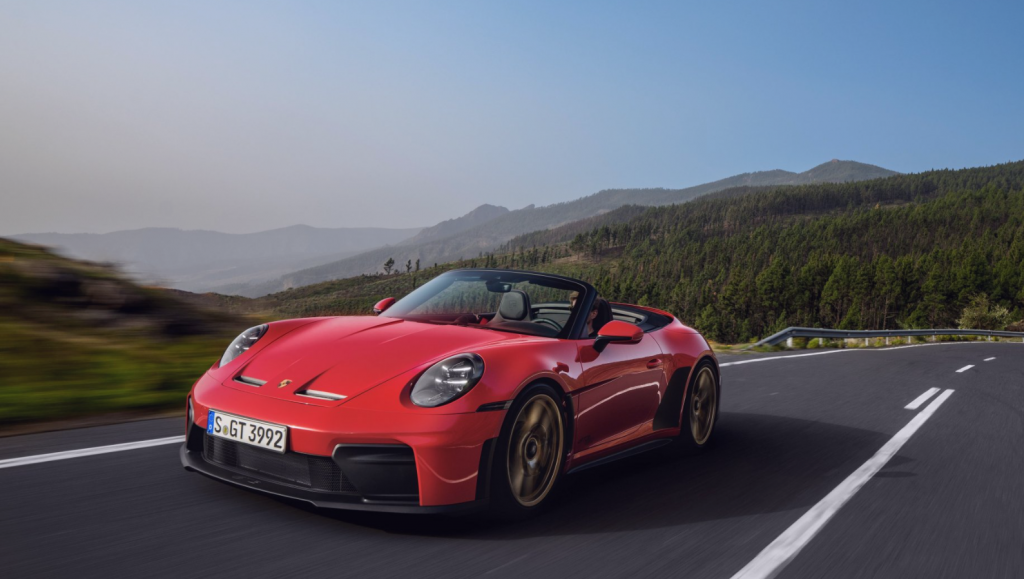
The Porsche GT family has welcomed a particularly exciting new member. The 911 GT3 S/C allows fans of the high-revving boxer engine to enjoy its unique naturally aspirated sound even without a fixed roof. It combines a range of ‘driver’s car’ qualities that have already delighted customers of the limited-edition 911 Speedster and 911 S/T models.
For the first time, Porsche is introducing a 911 GT3 with a fully automatic convertible roof. The 911 GT3 S/C, designed especially with driving pleasure in mind, combines the lightweight design of the 911 S/T with the naturally aspirated 4.0-litre boxer engine of the 911 GT3, producing 375 kW (510 PS) and 450 Nm of torque. The distinctive wings and doors of the 911 S/T in combination with the black windscreen surround give the new 911 GT3 S/C an unmistakable look.
In line with its positioning as a driver’s car, this special model is available exclusively with a lightweight short-ratio six-speed manual sports transmission. The 911 GT3 S/C is the only open-top variant in the current 911 range that is designed as a pure two-seater – reminiscent of the 911 Speedster from 2019. Unlike the Speedster, however, the 911 GT3 S/C is not a limited-edition model. The new Street Style Package is also available for the 911 GT3 S/C, which allows the vehicle to be tailored even more precisely to individual tastes.
According to Frank Moser, Head of the 911 and 718 model series, the new 911 GT3 S/C caters to customers’ demand for sports cars that are particularly focused on driving pleasure: “The emotive powertrain of the 911 GT3 comes into its own even more emphatically when driving with the roof down on winding country roads. This is particularly down to managing to keep the weight of the 911 GT3 S/C down to just 1,497 kilograms, despite the fully automatic soft top. That is only about 30 kg more than the 991-generation 911 Speedster.”
The combination of particularly lightweight and high-quality materials ensures that the 911 GT3 S/C shines with the characteristic agility of Porsche GT models. The lightweight body components carried over from the 911 S/T are recognisable, even at first glance. The bonnet, wings and doors are made of carbon fibre. The carbon-fibre anti-roll bars and shear plate are also carried over from the fixed-head 911 S/T. The brakes and wheels also follow the S/T lightweight formula: the PCCB braking system, which is more than 20 kg lighter than the cast iron brakes, is fitted as standard.
The centre-lock wheels, measuring 20 inches in diameter on the front axle and 21 inches at the rear, also from the 911 S/T, are made of lightweight magnesium. This saves around nine kilograms of rotating mass. Magnesium is also used in the fully automatic cabriolet roof of the 911 GT3 S/C. A lightweight and compact 40 Ah lithium-ion battery further contributes to the car’s impressively low weight, saving about four kg compared to a conventional battery.
The naturally aspirated 4.0-litre engine of the new 911 GT3 S/C is designed to comply with the latest emissions standards and is equipped with two particulate filters and four catalytic converters. Even with this extremely efficient exhaust gas purification system, Porsche delivers an emotionally engaging soundscape that is significantly intensified when the roof is down. The cylinder heads have been revised compared to the previous-generation 911 GT3, and the more aggressive camshafts carried over from the 911 GT3 RS ensure even more responsive power delivery in the upper rev range.
The powertrain also features flow-optimised individual throttle bodies and further optimised oil coolers. The flat-six engine produces 375 kW (510 PS). The six-speed GT manual transmission features a sporty short final-drive ratio that matches that of the 911 S/T and the 911 GT3. The new 911 GT3 S/C accelerates from 0 to 100 km/h in 3.9 seconds and reaches a top speed of 313 km/h.
For more news like this, click here.