
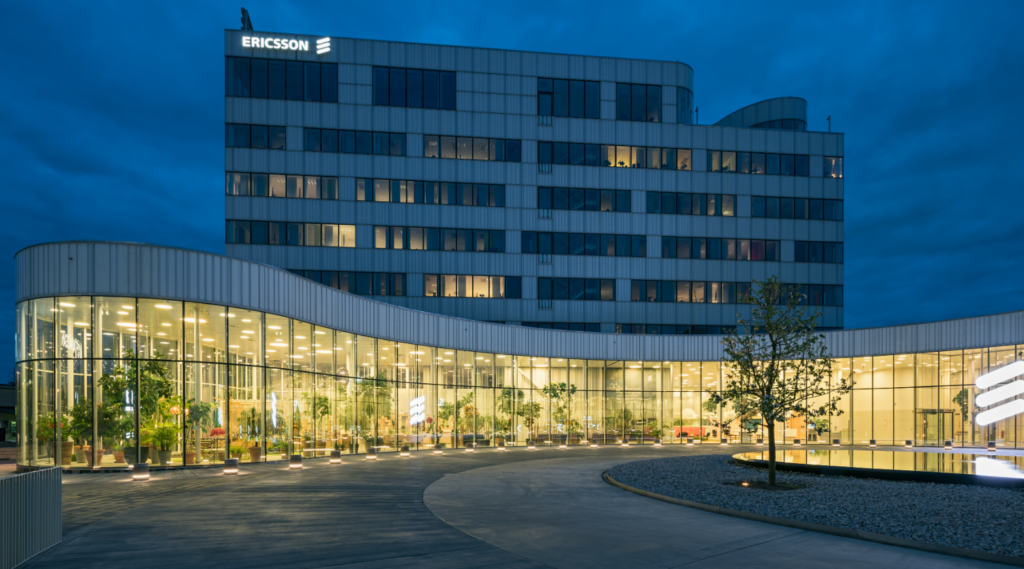
Ericsson has introduced a new technology that enables existing mobile networks to detect and track drones, offering additional security capabilities for critical infrastructure, public safety and defence operations.
Announced on 2 November 2026, the Ericsson Integrated Sensing and Communication (ISAC) System uses existing 5G infrastructure to identify and monitor moving objects across wide areas, including drones that are not connected to mobile networks.
The launch follows successful testing of the technology, with Ericsson planning to introduce small-scale commercial pilots in 2027 before progressing towards broader deployments from 2028. The system is designed to complement existing radar and other dedicated sensors, providing an additional layer of surveillance and situational awareness without requiring an entirely separate network of detection infrastructure.
Using 5G networks to detect drones
Small, low-cost drones are increasingly creating security challenges for organisations responsible for protecting critical infrastructure and monitoring sensitive locations.
Their size, ability to operate at low altitudes and relatively low cost can make them difficult to detect across large geographical areas. Traditional radar and dedicated detection systems remain important for protecting critical sites, but extending these technologies across wider areas can require significant additional infrastructure.
Ericsson’s ISAC System is designed to address this challenge by introducing sensing capabilities into mobile networks. Using sensing-capable 5G radios, edge computing, signal processing and AI-based classification, the system can detect and track moving objects by analysing how radio signals are reflected within the surrounding environment.
The technology operates through a multi-static architecture, with sensing signals transmitted and received across multiple geographically separated mobile network sites. This allows objects to be observed from different angles, supporting more accurate positioning, continuous tracking and improved detection reliability.
Building on existing telecommunications infrastructure
A key feature of the Ericsson ISAC System is its ability to use elements of existing 5G infrastructure, including mobile towers, backhaul connections and radio spectrum. By incorporating sensing technology into communications networks, operators can provide additional monitoring capabilities across cities, transport corridors and strategically important locations.
The system generates tracking information that can be securely shared with authorised external platforms, including security management and command-and-control systems.
This enables network-based detection information to be combined with traditional radar, acoustic sensors and other monitoring technologies.
Freddie Södergren, Global Head of Mission Critical Networks and Defense at Ericsson, explained that low-flying drones create detection challenges that cannot always be addressed effectively by a single sensor technology.
The company believes that coordinating sensing capabilities across multiple 5G sites can improve coverage while providing telecommunications operators with opportunities to develop additional services using their existing infrastructure.
Successful international demonstrations
Ericsson has conducted a series of live demonstrations with telecommunications and technology partners to evaluate the system’s detection and tracking capabilities.
In Arlington, Texas, Ericsson worked with AT&T to demonstrate how mobile network sensing could detect, locate and track multiple drones.
The trial used sensing dashboards to display drone movements and examined potential applications for protecting stadiums, major venues and critical infrastructure.
A separate demonstration in Helsinki, Finland, involved Erillisverkot, where multiple 5G sites were used to detect and track drones.
The testing explored how mobile network sensing could support public safety and counter-drone operations while extending coverage alongside traditional detection systems.
In Poland, Ericsson collaborated with telecommunications operator Play and technology company Asseco.
The demonstration combined Ericsson’s sensing technology, Play’s mobile network and Asseco’s PUSZCZYK acoustic detection system to improve the detection and positioning of low-flying drones.
Ericsson reports that validated testing demonstrated reliable detection and tracking of micro drones at kilometre-scale distances, with precise three-dimensional positioning.
The company notes that real-world performance depends on factors including terrain, drone characteristics, sensing geometry and network configuration.
Applications across critical infrastructure and transport
Ericsson has identified several potential applications for its ISAC technology. For defence and public safety organisations, the system could provide additional airspace monitoring across borders, coastlines and strategically important locations. Critical infrastructure operators could use the technology to improve monitoring around ports, power stations and other essential facilities. Transport and industrial organisations may also benefit from enhanced situational awareness across roads, rail networks and operational environments.
Beyond security, Ericsson sees potential applications in drone traffic management, urban airspace monitoring, smart-city planning and environmental mapping. These uses could support the development of low-altitude aviation services as commercial drone operations become more widespread.
Commercial pilots planned for 2027
Ericsson plans to introduce the ISAC System in phases, beginning with selected small-scale, sensing-only commercial pilots during 2027. Broader sensing deployments are expected to follow in 2028, with integrated communication capabilities planned as the technology develops towards future 6G networks.
The company’s approach reflects the potential for mobile networks to provide services beyond traditional voice and data connectivity.
By enabling communications infrastructure to detect and track physical objects, Ericsson aims to create additional applications for existing network assets while supporting the protection of critical infrastructure.
The announcement marks a further development in the use of telecommunications technology for security, industrial monitoring and public safety.