
Cambridge-based FocalPoint has announced the expansion of its S-GNSS satellite positioning technology into robotics and smart city applications, aiming to improve location accuracy and reliability for autonomous systems operating in complex environments.
Announced on 24 November 2026, the development extends the company’s positioning technology beyond its established automotive applications to support mobile robots, delivery drones and micromobility platforms.
The expansion focuses on a central challenge facing autonomous devices: maintaining dependable positioning when satellite signals are disrupted by buildings, vegetation and other physical obstacles.
Improving satellite positioning in urban environments
Global Navigation Satellite Systems (GNSS) are widely used to determine the location of vehicles, connected devices and autonomous equipment.
However, conventional satellite positioning can become less reliable in dense urban environments, where tall buildings reflect satellite signals before they reach a receiver.
These reflections, known as multipath interference, can cause positioning errors.
Similar problems can arise beneath thick vegetation, around physical obstructions or when a device’s antenna cannot be placed in an optimal position.
For mobile robots and other autonomous systems, accurate positioning is important because equipment must make navigation decisions without continuous human intervention.
FocalPoint is extending its technology into these markets to help address the challenges associated with unreliable satellite signals.
Using Supercorrelation signal processing
At the centre of FocalPoint’s offering is its proprietary Supercorrelation signal-processing technology.
The software operates at the GNSS receiver level, helping improve the way positioning information is extracted from satellite signals.
According to FocalPoint, Supercorrelation improves positioning accuracy in environments affected by multipath interference, including streets surrounded by tall buildings.
The company also says the technology strengthens resilience against satellite signal jamming and spoofing.
Jamming involves interference that disrupts the reception of legitimate positioning signals, while spoofing involves misleading a receiver with false positioning information.
Both can create problems for autonomous equipment that depends on reliable location data.
FocalPoint says its technology can also help recover positioning performance when antenna placement is compromised by the compact design of a device.
Importantly, the approach works with existing GNSS receiver hardware and does not require additional sensors.
This could provide equipment manufacturers with a software-based route to improving satellite positioning performance.
Supporting mobile robots and delivery drones
The expansion into robotics and smart cities is intended to support a growing range of autonomous and connected systems.
These include delivery drones, mobile robots and micromobility platforms operating in public spaces.
Such applications frequently encounter positioning challenges that are less common in controlled environments.
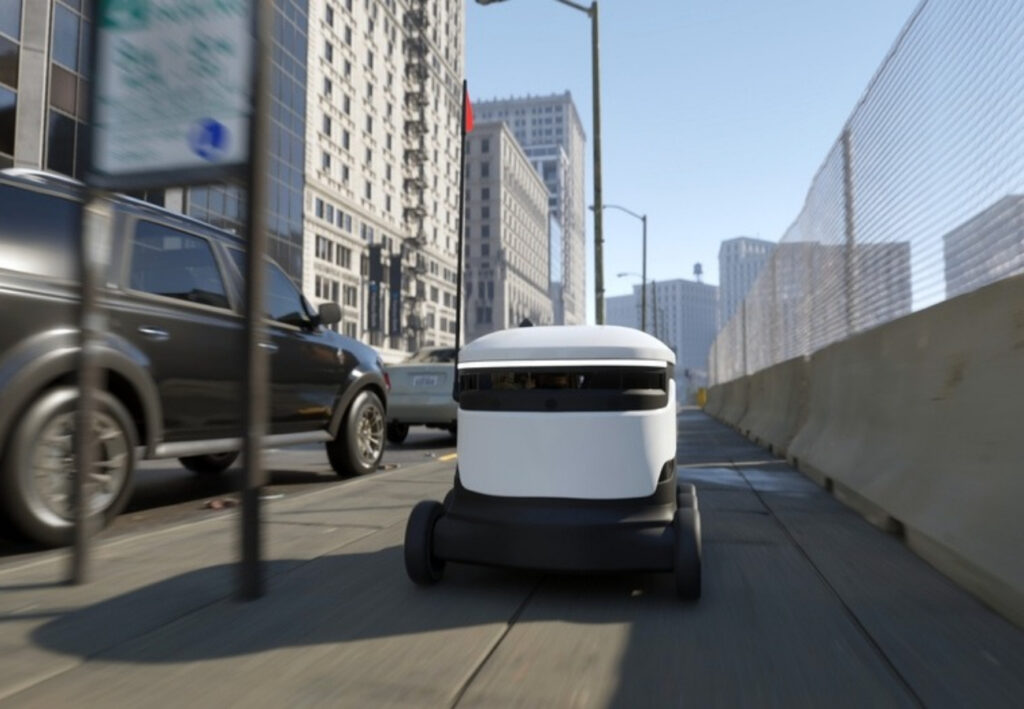
An autonomous delivery robot, for example, may need to navigate between buildings, identify its location near a road crossing or maintain accurate route information when satellite signals are obstructed.
Similarly, drones operating around urban infrastructure require reliable positioning information to support safe navigation.
FocalPoint is positioning S-GNSS as an additional capability for manufacturers developing devices that depend on satellite navigation.
The announcement does not identify new robotics customers or confirm specific deployments resulting from this market expansion.
Building on existing automotive technology
FocalPoint’s S-GNSS technology is already commercially available for automotive applications through its collaboration with STMicroelectronics.
The companies have integrated S-GNSS Auto with STMicroelectronics’ Teseo GNSS receivers, allowing compatible devices to access enhanced positioning capabilities through a firmware upgrade.
The solution is designed to support applications including advanced driver assistance systems, autonomous driving and vehicle-to-everything communications.
FocalPoint says the existing integration demonstrates how its software can be incorporated into established receiver hardware.
The expansion into robotics and smart cities applies the same underlying approach to additional devices and operating environments.
The company is headquartered in Cambridge, UK, and develops satellite positioning software for connected and autonomous systems.
Developing sub-metre positioning technology
Alongside its S-GNSS market expansion, FocalPoint is working with chipset manufacturers to bring a separate offering, Precise+, to market.
The technology is being developed to provide sub-metre positioning accuracy for applications requiring greater location precision.
FocalPoint has identified agricultural and construction machinery as potential applications.
In these environments, positioning accuracy can influence machine operation, productivity and safety.
Precise+ remains a development and commercialisation initiative. FocalPoint has not announced its general availability as part of the 24 November release.
Supporting the growth of physical AI
Scott Pomerantz, Chief Executive Officer of FocalPoint Positioning, said reliable positioning is becoming increasingly important as intelligent machines move beyond controlled environments.
He explained that autonomous systems need dependable information about their location to navigate safely in real-world conditions.
FocalPoint plans to demonstrate its positioning technology at CES 2027 in Las Vegas, taking place from 6 to 9 January.
The company’s expansion into robotics and smart cities reflects the increasing importance of navigation reliability as autonomous devices are introduced into more complex operating environments.
By extending its existing satellite positioning software beyond automotive applications, FocalPoint aims to support equipment manufacturers developing the next generation of mobile robots, delivery systems and connected infrastructure.
IMAGE CREDIT – FocalPoint