
IBM has announced its next-generation Quantum Nighthawk r3 processor, designed to support increasingly complex quantum computations, alongside plans to connect two processors into a system exceeding 1,000 programmable qubits in 2027.
Unveiled on 11 November 2026, Nighthawk r3 will support computations involving up to 10,000 quantum operations across 520 programmable qubits.
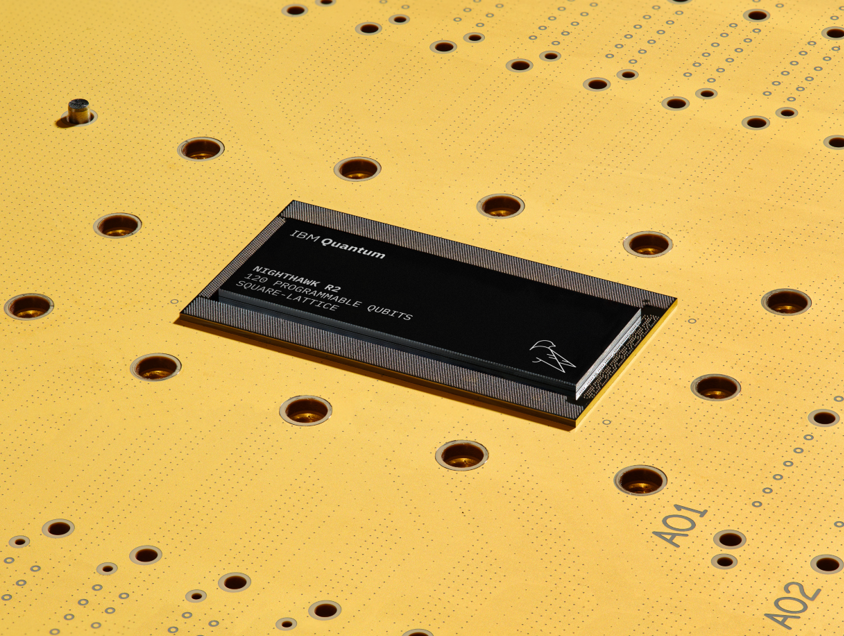
The announcement builds on IBM’s existing Nighthawk r2 processor, which is already demonstrating improvements in computational speed and performance across scientific and industrial research applications.
The development forms part of IBM’s longer-term strategy to advance quantum computing towards larger, more reliable systems capable of addressing complex computational problems.
Advancing quantum computing performance
IBM Quantum Nighthawk r2, introduced in September 2026, is designed to deliver up to 100,000 samples per second while supporting computations involving more than 7,500 quantum operations across 120 qubits.
The processor incorporates high-speed qubit reset technology, reducing the time required between circuit executions and allowing researchers to collect large volumes of computational results more efficiently.
According to IBM, customers and research partners including E.ON, Algorithmiq and Q-CTRL have executed more than 34 billion quantum circuits using Nighthawk r2.
Participating organisations have reported performance improvements of up to 19 times compared with previous IBM quantum processors on selected workloads.
Energy company E.ON reported a 15-fold speed improvement in quantum machine learning experiments focused on electricity grid optimisation.
IBM also achieved a 12-fold improvement in an experiment conducted with Oak Ridge National Laboratory involving the simulation of magnetic materials.
These results demonstrate progress in applying quantum computing technology to complex research tasks, although performance improvements vary depending on the application.
Scaling beyond 1,000 qubits
The next-generation Nighthawk r3 processor will introduce significant architectural developments intended to support larger quantum systems.
Each processor is designed to incorporate 520 programmable qubits and 2,034 physical qubits, while maintaining the high-speed operations and connectivity developed for Nighthawk r2.
IBM plans to introduce ten chip-to-chip connections, known as l-couplers, allowing individual processors to communicate within a larger quantum system.
The company has already demonstrated quantum state transfer between connected Nighthawk r1 processors, achieving 99.3% transfer fidelity as it works towards a target of 99.9%.
IBM has also connected two cryogenic modules within a single system, demonstrating progress towards the infrastructure required for larger quantum computers.
In 2027, IBM plans to connect two Nighthawk r3 processors to create a system with 1,040 programmable qubits.
The proposed architecture is intended to support increasingly demanding computations while progressing towards more scalable quantum computing systems.
Integrating quantum and classical computing
Alongside its processor developments, IBM is expanding the integration of quantum and classical high-performance computing through the IBM Quantum Platform.
The enhanced platform enables researchers to combine quantum workloads with conventional computing resources, including high-performance computing systems.
This integration is particularly important for managing errors, processing computational results and supporting increasingly complex quantum algorithms.
IBM and RIKEN researchers have demonstrated improvements in quantum-classical workflows using the integrated platform, including faster execution of sample-based quantum diagonalisation experiments.
The company is also collaborating with Oak Ridge National Laboratory and AMD on quantum error correction, combining quantum systems with conventional computing resources.
Supporting future commercial applications
Jay Gambetta, Director of IBM Research and IBM Fellow, emphasised the importance of both speed and accuracy in developing quantum computing technology.
The latest announcements reflect IBM’s efforts to improve processor performance, expand quantum system capacity and develop the supporting infrastructure required for fault-tolerant computing.
Although Nighthawk r2 is already available, Nighthawk r3 and the proposed 1,040-qubit system remain planned developments.
With further progress expected in 2027, IBM is continuing to develop the hardware and computing architecture required to bring quantum technology closer to practical applications across scientific research, energy, materials and other computationally intensive industries.
IMAGE CREDIT: IBM