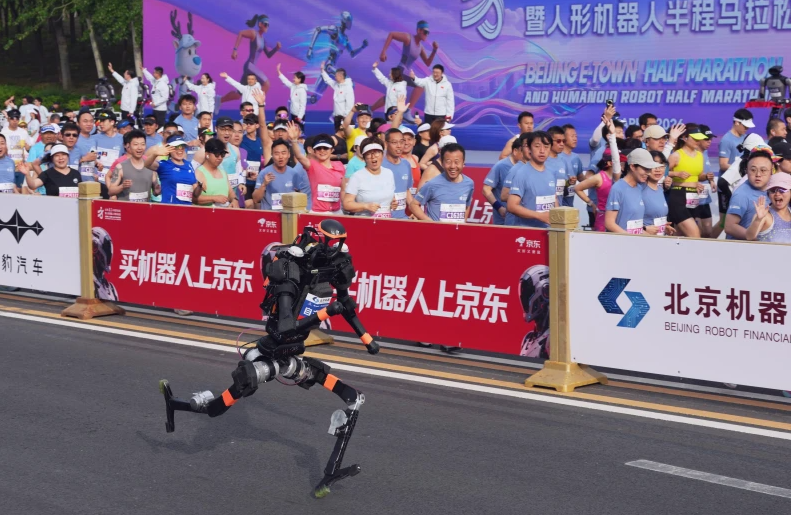
A humanoid robot developed by Chinese technology firm Honor completed a half-marathon in Beijing this past Sunday, recording a time faster than the current human world record. The event, held in the Beijing Economic-Technological Development Area (Beijing E-Town), served as a demonstration of recent advancements in robotic mobility and endurance.
The robot finished the 21-kilometer (13-mile) course in 50 minutes and 26 seconds. For comparison, the human world record for the same distance is 57 minutes and 31 seconds, established by Uganda’s Jacob Kiplimo.
The performance represents a marked increase in mechanical efficiency compared to the previous year’s event, where the winning robot required over two hours to complete the course. According to Honor’s test development engineer, Du Xiaodi, the robot’s physical architecture was designed to mirror human athletic proportions, featuring legs approximately 95 cm in length.
To manage the heat generated during high-speed locomotion, the unit utilised a proprietary liquid-cooling system. Engineers indicated that the structural and thermal technologies refined for this race are intended for eventual application in industrial and manufacturing environments.
The race featured varying levels of robotic autonomy. Approximately 40% of the robots navigated the course using onboard systems and the remaining units were operated by human controllers.
While a remotely-piloted unit recorded the fastest raw time of 48 minutes and 19 seconds, the official championship was awarded to the autonomous Honor model. The event’s scoring system prioritised self-navigating capabilities over remotely-assisted speed.
The race was not without technical difficulties; several units failed to navigate the start or maintain balance when encountering course barriers, highlighting ongoing challenges in bipedal stability.
The development of humanoid robotics is a primary objective within China’s 2026–2030 economic and scientific strategy. National policy currently emphasises the advancement of “embodied intelligence” to maintain competitiveness in the global technology sector.
Data from the research group Omdia indicates that Chinese manufacturers, including AGIBOT and Unitree Robotics, currently lead in shipment volumes for general-purpose humanoid robots. Several of these firms reported shipping over 5,000 units in the previous year, suggesting a shift from experimental prototypes toward larger-scale production.
For more news like this, click here.